Monday, November 26, 2012

Final Report Overview


Developing a Structured E-Government Strategy

Introduction
  • Many e-governance initiatives have been implemented around the world, especially in the countries like the U.S., Canada, Western European countries, Singapore, and Australia.
  • The rest of the world is catching up.
  • Many of the e-government initiatives are failing or progressing slowly.
  • One of the biggest reasons is poor e-government strategy development.
  •  According to previous studies, many organizations said that they were not following a strategy, but a list of short-term goals.
  • Research Problem: How can a structured approach be developed for the formation and development of e-government strategy?
Literature Review:
  • E-government is at the core of building a strategic sustainable development framework.
  • One of its key functions has been to provide an integrated framework of policies, laws and regulations and develop institutions and processes that allow the private sector to provide – and the people to partake of – the benefits of newer technologies.[ United Nations E-Government Survey 2012].
  • According to research findings done by means of interviews and questionnaires with a sample comprising of several governmental organizations in the gcc countries, when asked what plans/strategies do organizations have, to go about e-government projects? None of the responding organizations indicated to have an e- government strategy but rather a set of guidelines and short-term plans. [ Electronic Government in the GCC Countries]
  • In order for e-government initiatives to truly succeed, we need to develop public trust and confidence to promote diffusion and participation. [E-government Strategies The Case of the United Arab Emirates (UAE)].
  • The success of e-government programs calls for strategic direction, policymaking and greater coordination among multiple agencies. This necessitates a strategic framework comprehensive enough to visualize and enable the leaders in addressing the potential roadblocks or resistance. [A strategy framework for the risk assessment and mitigation for large e-Government projects].
  • Judging from these previous studies, structured strategy formation and development is a key success factor in the e-government implementation.
  • In order to move forward with the e-government plan, a detailed study of the number one obstacle, which is the security concern, must be done to develop a suitable solution.
Current UAE E-Government Status
  • The first e-government initiative in the UAE started in 2001, it was an electronic card, called eDirham.
  • Since 2001, many entities started creating different eservices to be more time and cost efficient.
  • Up until 2005, most e-government initiatives were the responsibility of the Ministry of Finance. In 2006, a ministerial decree was issued to transfer the e-government program from the Ministry of Finance to the Ministry of Government Sector Development.
  • In 2005, The UAE national identity management infrastructure was developed. It is a strategic initiative to enhance homeland security and develop a federated identity management system enabling secure e-government transactions.
  • According to The United Nations E-Government Survey, The UAE’s overall rank in the 2010 survey was 49th, while in 2012, UAE was advanced to rank 28th, which is the first in Arab countries, and fifth in Asia.
  • The official portal of the UAE Government is www.government.ae
  • It is part of the federal eGovernment program.
  • The purpose of this portal is to provide better services to the citizens and to involve them in government’s policies, laws, and public initiatives to achieve transparency.
What’s left:
  • Creating a structured e-government strategy by first understanding what e-government means and why implement it. 
  • How to accurately implement the e-government strategy
  • How to address the security concerns?
Notes from Saturday November 24th, and Sunday November 25th


  • Web service allows interoperability and agility
  • Enterprise Architects are like city planners
  • Responsibility for ensuring that IT delivers the required business results resides with the organization as a whole.
  • Most important aspect for any program’s success is stakeholder involvement
  • According to Weil and Ross, governance structures have three characteristics; simple, transparent, and suitable.
  • To synthesise a strategy requires a comprehensive architectural model across all elements of the enterprise.
  • Non-functional “emergent” requirements include openness, performance, evolvability, security, maintainability, and reliability

Friday, November 23, 2012

Enterprise Architecture in the Singapore Government


Singapore's e-government progress:
  • 1980-1999: Civil Service Computerization Program (CSCP)
  • 2000-2003: E-Government Action Plan I (eGAP I)
  • 2003-2006:E-Government Action Plan II (eGAP II)

E-Government Action Plan I (eGAP I)'s achievements include:
  • one of the most advanced e-governments in the world
  • over 1600 public e-services have been implemented
  • general public satisfaction with the e-government

E-Government Action Plan II (eGAP II)'s goals: delighted customers and connected citizens through networked

Thursday, November 22, 2012

Web Services

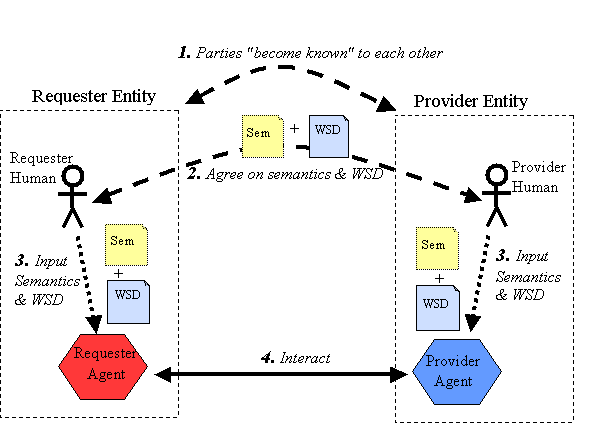
The term Web services describes a standardized way of integrating Web-based applications using the XML, SOAP, WSDL and UDDI open standards over an Internet protocol backbone. XML is used to tag the data, SOAP is used to transfer the data, WSDL is used for describing the services available and UDDI is used for listing what services are available. Used primarily as a means for businesses to communicate with each other and with clients, Web services allow organizations to communicate data without intimate knowledge of each other's IT systems behind the firewall.


Sources: w3.org, http://www.webopedia.com/

Sunday, November 18, 2012

FEAF

  • FEAF stands for federal enterprise architecture framework
  • It is the enterprise architecture for a federal government
  • It provides a methodology for IT acquisition, use, and disposal in a federal government
  • The FEA is built using an number of reference models, they are:
  1. performance reference model,
  2. business reference model,
  3. service component reference model,
  4. data reference model
  5. technical reference model.
  • It is designed to ease sharing of information and resources across federal agencies, reduce costs, and improve citizen services.
  • Eight components taken into consideration to design and maintain FEAF:
  1. architecture drivers
  2. strategic direction
  3. current architecture
  4. target architecture
  5. transitional processes
  6. architectural segments
  7. architectural models
  8. standards
  • FEA Architecture levels:
  1. Enterprise architecture,
  2. Segment architecture,
  3. Solution architecture.
Resources: wikipedia, whitehouse.gov

For more info: http://www.whitehouse.gov/sites/default/files/omb/assets/fea_docs/FEA_Practice_Guidance_Nov_2007.pdf

Saturday, November 17, 2012

November 15th and 17th Class Notes


November 15th: Enterprise Architecture Framework for Agile and Interoperable Virtual Enterprises
  • Problems of generic enterprise modeling languages: 1)many diagrams but no relations 2) Too general
  • Agility: Adaptability, responding quickly
  • Interoperability: ability to communicate seamlessly
  • Problems with developing VEs: 1) enterprises are diverse and complex 2)many stakeholders 3)business processes are heterogeneous and distributed


November 17th: Business Process Modeling as a Blueprint for Enterprise Architecture

  • Primary resources for enterprises: 1)users 2)processes 3) technology
  • Process is the most important because it connects users and technology
  • Tools to support enterprise process modeling: data flow diagrams, and activity diagrams


Monday, November 12, 2012

Chapter + Section Summary


Summary of The Syngenta story

Syngenta ia world leading agribusiness committed to sustainable agriculture through innovative research and technology
The comany's business strategy focuses on three major market areas-agri, consumer-led, and new. Another way of leveling these areas is efficiency, growth, and innovation

Summary of Saturday's class (chapters 21 and 22)

  • Modeling processes translate the enterprise specifications to fulfill requirements.
  • To deal with a huge project, look for common ground across different functions
  • An object is an instance of a class, example: (class: person, object: librarian)
  • Metadata is data about data
  • An Example of technical metadata: Cust_id( alphanumeric, length, location, database,…)
  • An example of a business metadata: Cust_id= customer id number
  • Activities are actions, processes are a series of activities
  • you can schedule an activity but not a process
  • Processes are triggered by events, example: course registration is triggered by student registration request form


Summary of the section Implementation and deployment

  • E-governance is emerging as a strategic tool for governance and international relations.
  • The design and development of federated ERP is subject to a lot of problems and a lot of work and studies and work is being done to solve them.
  • The scope of enterprise architecture is AS-Is, TO-BE, and Governance.
  • Effective EA is both a technical and a social activity because both analytical and personal skills are important.
  • Modeling processes translate the enterprise specifications to fulfill requirements


Monday, November 5, 2012

Requirements of an Enterprise Architect in The Local and The Global Job Market

A job-hunter for an enterprise architect position in the U.S, will have to posses the following requirements*: 


  • 12+ years of overall enterprise IT experience
  • 6+ years of experience in Software, enterprise, or solutions architecture
  • Familiar with both Java and Microsoft Technologies.
  • Deep background in Application Design and Development.
  • Solid understanding of Design Patterns.
  • Advanced knowledge of SOA and all SOA-based design and implementation.
  • Exposure to a variety of technologies, Including, but not limited to: WebSphere or Weblogic, J2EE (JSP, Servlets, EJB, XML, Java), .Net (ASP.NET, WCF), Oracle, Microsoft SQL Server.
  • Oracle SOA Suite experience is a plus.
  • Performance tuning of Operating Systems, Applications, Databases.
  • Demonstrable experience automating complex tasks
  • Must have the capacity to be decisive and flexible
*these requirements are based on one job opportunity in one location

Whereas an enterprise architect job in the UAE may require the following*:

  • Qualifications 
    Essential 
    • Bachelors level degree in a computer science or similar discipline 
    • Proven Enterprise Application Development / Architecture skills 
    • Knowledge of ICT best practice in the major enterprise architecture areas, and a working understanding / knowledge best practice at CTO level 


    J2EE, SOA, ESB, MQ, MQSI, SOAP, Workflow, Imaging, EAI, Event Driven Architecture, Web Services, Rational Unifies Process (RUP), XML, UML, BPEL, SAML and ETL Technologies 
    • Arabic language ability 

    Experience 
    Essential 
    • A highly experienced ICT professional with experience of leading ICT teams on a range of fronts simultaneously -namely client management, solutions architecture, service and programme management 
    • Significant (10 years plus) experience of ICT enterprise architecture and delivery and working with senior officers within public sector organizations with demonstrated experience supporting a broad spectrum of detailed IT planning and engineering at an enterprise and system architecture level 

    Skills

    • Bachelors level degree in a computer science or similar discipline
    • Proven Enterprise Application Development / Architecture skills
    • Knowledge of ICT best practice in the major enterprise architecture areas, and a working understanding / knowledge best practice at CTO level
    *these requirements are based on one job opportunity in one location


    Can you spot the differences/similarities?

    Enterprise Architecture as an enabler for E-governance


    Zachman's Framework

    An Indian Perspective
    There are several e-governance initiatives in India, like e-Choupal, E-SEVA,Bhoomi, and NeGAP.
    NeGAP is the national e-governance action plan formed by the Indian government.It visualizes a set of core policies and infrastructure facilities to facilitate central level, state level, and integrated level egovernance intitiatives to provide citizen-centric and business-centrice service delivery.

    They reported many challenges including: last mile connectivity, availability of power, maintenance of infrastructure, lack of content, lack of language, lack of suitable legal frameworks, and many other challenges listed in the book.
    Source: Handbook of Enterprise Systems Architecture In Practice.

    Friday, November 2, 2012

    Lessons 1 & 2 Notes


    Lesson 1: November 1st, 2012

    An "enterprise" can be many things, like a company, a project, or a city. Each enterprise has many components like people, resources and each work towards a common goal.
    Any enterprise at one point or another has to go through changes and to implement change effectively, previous studies must be done and a key component is the enterprise's blueprint.

    Lesson 2: November 3rd,2012

    SME's/SMB's ( Small and Medium Enterprises/ Small and Medium Businesses) contribute more to the local economy than large enterprises.
    An ERP system is a system that integrates the different components of an organization into one system to reduce duplication and inconsistency of data. A federated ERP is a proposed solution that will help smaller organization to adopt ERP. The difference between ERP and FERP is that the ERP is provided by one vendor and the many servers needed to run the ERP are stored in one location, usually the company, and they are accessed through the company's intranet. The ERP costs a lot of money and contains many components that smaller companies don't need and can't afford.
    Using FERP, small companies can select which components they need (for example, HR, Finance, and IT) and they can get each component from different vendors. The servers can be located at each vendor and can be accessed through web services. The web service layer acts as an access point between the servers and the ERP components.